Research-Creation · AI / Archives / Memory
MA Cinema & Media Studies, York University · 2026–27
MA Cinema & Media Studies, York University · 2026–27
Conversations Across Time (CAT) is a research-creation project exploring how AI-mediated archival processes reshape affective, ethical, and interpretive experiences of familial memory through the family histories of Alfred John Doling and Lena Victoria Wiggins Doling.
1. Project Overview
Conversations Across Time explores what happens when a family archive is not only viewed, organized, and interpreted, but computationally reanimated. Working with photographs, documents, recorded voices, correspondence, and material traces connected to Alfred John Doling and Lena Victoria Wiggins Doling, the project uses AI-mediated image, voice, and moving-image processes to construct experimental encounters with the past.
Rather than attempting to reconstruct history as fact, the project asks how synthetic presence changes the experience of archival evidence—and what happens when those encounters send the researcher back to the archive with new questions.
2. The Family Archive
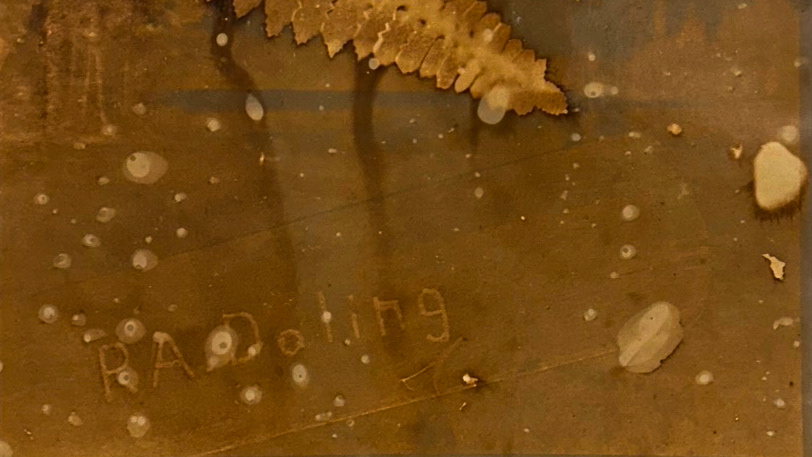
The project begins with a multigenerational family archive assembled from photographs, letters, poems, voice recordings, official records, military documents, immigration research, and personal objects.
At its centre are Alfred John Doling and Lena Victoria Wiggins Doling. Their lives connect Britain and Canada across war, migration, family life, and changing technologies of memory. Surviving archival fragments provide both the source material for the creative work and the limits against which synthetic reconstruction is tested.
The archive is treated not as a complete historical record, but as a collection of partial traces: things preserved, things remembered, and things absent.
3. From Archive to Synthetic Encounter
The creative process experiments with AI-assisted animation, synthetic voice, image restoration and alteration, and audiovisual editing to explore different forms of mediated presence.
Photographs can begin to move. Recorded voices can be modelled. Archival subjects can appear to speak across temporal distance.
These experiments are not treated as straightforward restorations of the past. Each transformation introduces interpretation, uncertainty, and technological intervention. The project therefore examines the tension between the emotional immediacy of synthetic presence and the historical limits of the source material from which that presence is constructed.
4. Research-Creation Process
The project develops through an iterative movement between archival research and creative experimentation:
archive → synthetic encounter → changed interpretation → return to archive
An AI-mediated experiment may reveal something visually or affectively compelling, but it can also expose inconsistencies, assumptions, or gaps in the historical record. Those discoveries generate new archival questions, which in turn reshape subsequent creative experiments.
This feedback loop has become central to the research. The synthetic encounter is therefore not simply an end product. It becomes a research instrument—one capable of changing how the original archive is read.
5. Ethics & Representation
Working with deceased family members raises questions of consent, authorship, authenticity, and representation. The project therefore distinguishes between archival evidence and AI-generated interpretation.
Where possible, surviving words and recorded voices provide the basis for representation. Synthetic additions, altered photographs, generated speech, and speculative reconstruction are documented as interventions rather than presented as recovered historical fact.
The research process also maintains dedicated ethics, reflection, process, and AI experimentation logs. These records make visible not only what the technologies can produce, but the decisions involved in determining what should—and should not—be produced.
6. Creative Work
The research culminates in Conversations Across Time, a short moving-image work structured around a series of encounters with Alfred and Lena.
The film combines archival material, synthetic audiovisual experiments, voice, editing, and the researcher’s own presence to explore the unstable space between historical evidence, family memory, imagination, and technologically mediated presence.
Rather than presenting a seamless recreation of the past, the work allows the mechanisms and uncertainties of reconstruction to remain visible. The audience is invited to experience the encounter while remaining aware of the archive—and the computational processes—from which it has been constructed.
7. Current Status
Conversations Across Time is currently in development as Brett Lackie’s MA research-creation Major Research Project in Cinema & Media Studies at York University.
Current work includes archival research, audio digitization and transcription, AI-assisted image and voice experimentation, development of encounter scenarios, ethical documentation, and moving-image production.
The final project will combine a short research-creation film with a written supporting paper examining how AI-mediated archival processes reshape affective, ethical, and interpretive experiences of familial memory.
2026–27 · Work in Progress